This project is now completed.
Thanks to Professor Carenza
Lewis and the University of Lincoln for making this project possible.
Pandemics in Ceramics
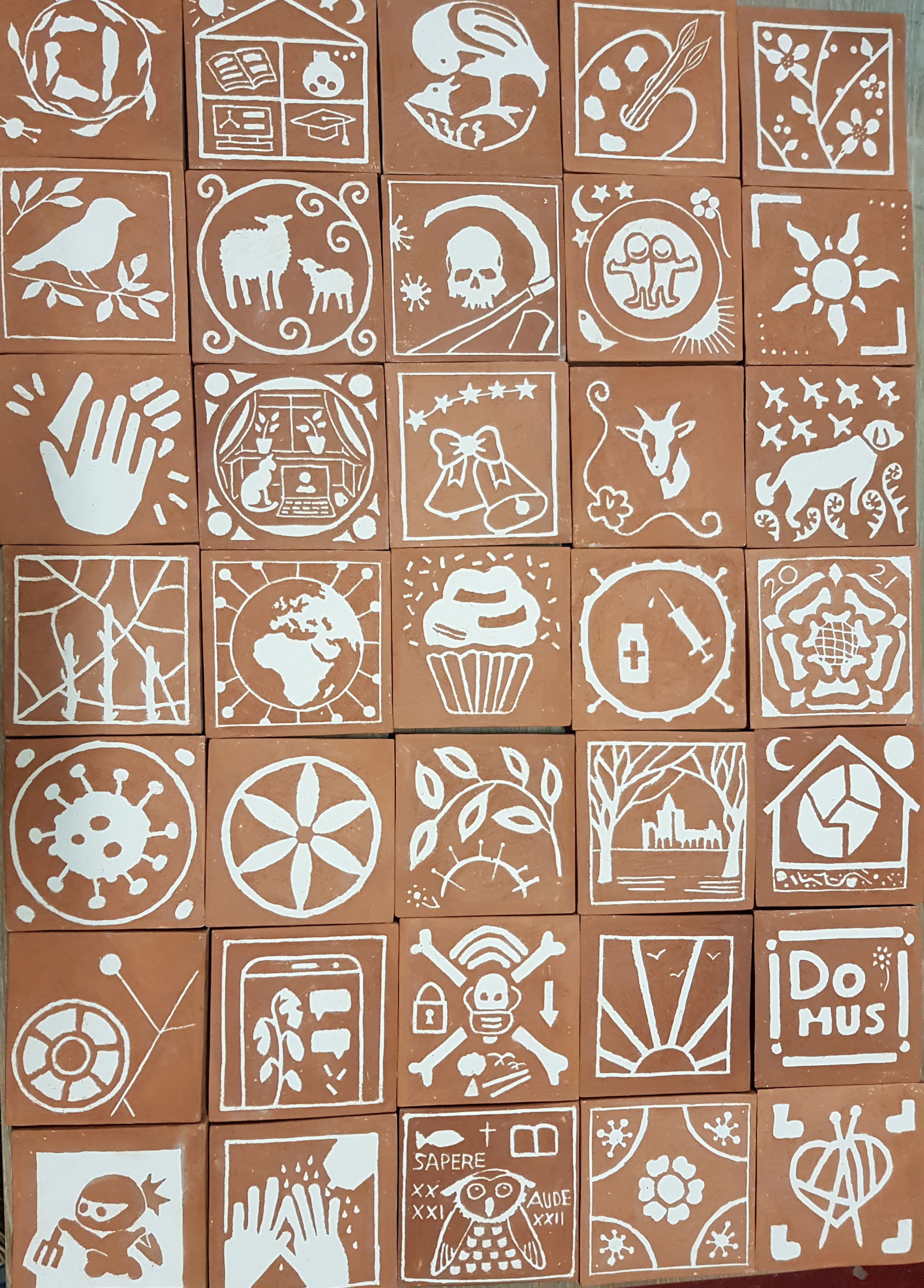
Pandemics in Ceramics was our way of helping people turn their own COVID‑19 experiences into something tangible: a single medieval‑style floor tile carved by hand. We built the project around Professor Carenza Lewis’s archaeological research at the University of Lincoln, which uses changes in the amount of medieval pottery to show how devastating the Black Death was for real communities.
Why We Wanted to Do This
Carenza’s data suggests England’s population after the Black Death may have been up to 45% lower—a loss of perhaps 2.5 million people. Before COVID‑19 that kind of historic pandemic felt distant; now all of us have a point of reference. We felt that linking today’s disruption with past resilience could offer perspective, a sense of continuity and a quiet reassurance that recovery is possible.
Pottery sherd counts are powerful evidence, but they’re small and abstract. Re‑creating the visual language of medieval inlaid floor tiles gave participants a medium that was instantly legible, expressive and rooted in craft. Clay lets stories settle into something you can touch.
How We Adapted the Tradition
Original 14th‑century tiles were made in batches: stamped wooden blocks pressed into clay, recesses filled with contrasting slip, then glazed and fired into those red‑and‑gold patterns you still see in surviving churches and abbeys. Our makers only had time for one tile each, so we stripped the process back—hand carving directly into a prepared square and encouraging strong, simple lines that would survive drying and firing.
We worked closely with Carenza to balance historical inspiration with an accessible, low‑pressure making experience. The goal wasn’t replica accuracy; it was a personal translation in a medieval visual frame.
What the Making Felt Like
Once people settled in, you could feel the focus in the room: that quiet absorption where time compresses. Conversations circled between design choices and the stories behind them—moments of humour, strain, adaptation and small wins.
What People Chose to Show
The collection became a snapshot of lockdown life: hygiene rituals (masks, hand sanitiser, elbow bumps), communal gestures (clapping for carers), and anchors that kept people steady—baking, knitting, dog walking, gardening, houseplants, remote work. Some tiles honoured the NHS with rainbows or initials; others acknowledged difficulty—a masked skull, an enclosed or fractured figure.
Medieval echoes surfaced naturally: an abbey seen on daily walks, a flower form with stylised coronaviruses in the spandrels. Narrative tiles stood out—a fishmonger whose lockdown reading led to enrolling in a history degree; a gardener weaving community by sharing an asparagus glut door‑to‑door; a walker quietly adding stones to an evolving cairn started by strangers.
Why It Mattered for Wellbeing
Without forcing it, the workshops folded in several evidence‑based wellbeing elements: mindfulness (immersive making), connection (sharing tile stories), giving (contributing to a collective commemorative piece), and learning (grasping historical pandemic impact through material culture). Together the tiles turn statistical demographic change into a textured surface of lived experience across centuries.
Our Thanks
We’re grateful to Professor Carenza Lewis for the research foundation and collaboration, and to every participant who trusted clay with their story. Your tiles carry more than images—they hold perspective and quiet resilience.